Dirac plasmons and magnetoplasmons
Plasmons and magnetoplasmons are collective oscillations of electrons that strongly affect photoinduced conductivity in field-effect transistors (FETs). This long-standing research theme within the team explores the physics of plasma waves in two-dimensional electron gases (2DEGs).
According to the Dyakonov–Shur theory, these charge-density waves, described within a hydrodynamic framework, can resonate in the terahertz (THz) range and even become unstable within the 2D channel of a FET. Before the advent of graphene, such phenomena had only been observed in a few ultra–high-mobility devices operating at low temperature [Appl. Phys. Lett. 92, 212101 (2008)].
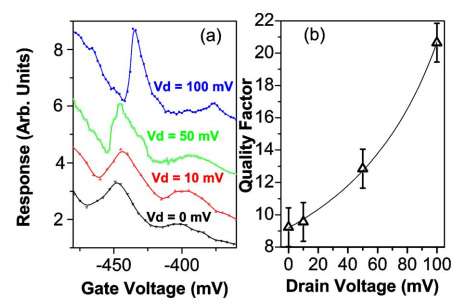
Photoconductivity at 540 GHz and 10 K as a function of gate voltage for different drain–source biases. Two plasma resonances are clearly visible, and their quality factor increases with the applied voltage in the FET channel. Credit: Appl. Phys. Lett. 92, 212101 (2008).
Thanks to its exceptional carrier mobility and high optical phonon energy, graphene has become an ideal platform to study these effects. Resonant plasmons have been observed up to room temperature, and their coupling with cyclotron resonance has revealed the existence of Dirac magnetoplasmons.
The team’s current research focuses on the THz photoconductivity of these excitations under various physical conditions, in order to probe electron–electron interactions in the hydrodynamic regime. In parallel, advanced device architectures are being developed — such as plasmon-based Mach–Zehnder interferometers — paving the way for new THz optoelectronic applications.