Landau polaritons and cyclotron emission
Exploiting cyclotron resonance in semiconductors opens a promising pathway toward the realization of THz lasers that can be tuned by either magnetic field or gate voltage. This phenomenon relies on the radiative recombination of non-equilibrium electrons between Landau levels in the presence of a magnetic field.
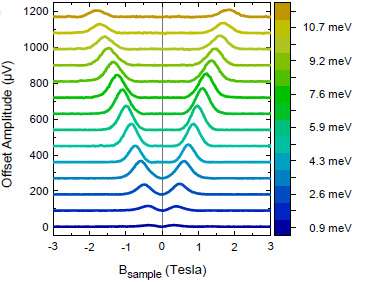
Cyclotron emission amplitude from Dirac fermions in HgTe quantum wells as a function of magnetic field for several detection energies. The emission can be tuned via the magnetic field and the carrier density. Owing to their relativistic nature, the effective mass of the carriers depends on their density in the well. Credit: Nat. Photon. 17, 244–249 (2023).
In materials with parabolic band dispersion, losses from non-radiative Auger processes prevent any light amplification. In contrast, in Dirac materials, the non-parabolic dispersion leads to unequally spaced Landau levels, which partially suppresses Auger scattering and reduces absorption — thereby enabling coherent emission [Nat. Photon. 17, 244–249 (2023)].
A current objective is to investigate cyclotron emission in various Dirac materials with exotic electronic band structures, including topological insulators and Weyl semimetals. A central question concerns the role of strong light–matter coupling, which can give rise to new hybrid excitations known as Landau polaritons.
The team is now exploring the non-equilibrium physics of these polaritons and the possibility of a Bose–Einstein condensation, which could ultimately lead to a cyclotron laser emission originating from these hybrid quasiparticles.