New topological phases
This research activity, at the crossroads of theory and experiment, explores the unconventional properties of semi-relativistic fermions — Kane, Dirac, and Weyl — observed in materials with particular band structures such as HgTe/HgCdTe, InAs/GaSb, NbAs, TaAs, and Cd₃As₂.
Using magnetospectroscopy techniques in the mid-infrared (MIR) and terahertz (THz) ranges, which probe optical transitions between Landau levels, we have revealed non-trivial topological gaps and phase transitions in HgTe/HgCdTe-based structures and InAs/GaSb heterostructures ([Nat. Commun. 7, 12576 (2016)]; [Phys. Rev. B 97, 245419 (2018)]).
The experimental validation of theoretical models, particularly for InAs/GaSb, has enabled us to refine modeling parameters and design new triple quantum well (TQW) structures, fabricated at the Institut d’Électronique et des Systèmes (IES). These devices exhibit good stability up to 100 K, paving the way for the study of the quantum spin Hall effect.
This mastery of III–V materials and their topological properties now opens the path toward exploring new exotic quantum states, such as the recent discovery of a new class of phases — higher-order topological insulators (HOTIs) [Scientific Reports 11, 21060 (2021)].
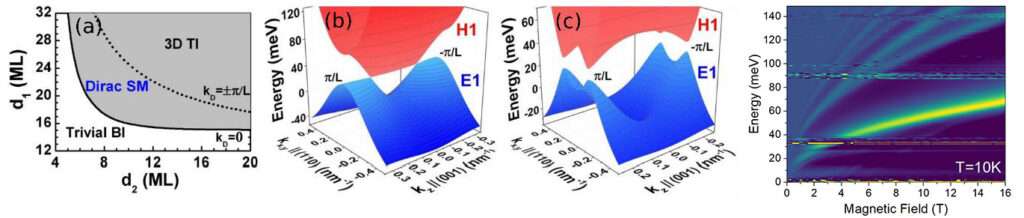
(a) Phase diagram of 3D superlattices (SLs) as a function of layer thicknesses d₁ and d₂. (b) Calculated band dispersion of a Dirac semimetal; (c) Calculated band dispersion of a 3D topological insulator (TI); (d)Magneto-absorption as a function of magnetic field at 10 K, revealing a √B dependence of Landau level energies down to a few meV, as expected for Dirac cones in a 3D Dirac semimetal. Credit: L2C/TEST.
Our work now extends to III–V superlattices, where we expect to uncover a rich variety of three-dimensional topological phases, such as Dirac semimetals (DSM), Weyl semimetals (WSM), and 3D topological insulators (TI).