Quantum spin Hall effect in III–V semiconductors
Topology — a concept recognized by the 2016 Nobel Prize in Physics — has profoundly transformed our understanding of conductors and insulators. Following the landmark discoveries of the quantum Hall effect and graphene, topological insulators have opened a new field of research at the crossroads of fundamental physics and quantum technologies.
Among these states of matter, the quantum spin Hall (QSH) effect represents a promising platform for dissipationless transport and quantum computing. It has been observed in various systems — HgTe and InAs/GaSb quantum wells, and later in WTe₂ — but only at low temperatures: a few kelvins for HgTe, below 1 K for InAs/GaSb, and up to 100 K for WTe₂, in technologically complex nanometric devices.
Today, an international effort is underway to stabilize the QSH state in materials that are both compatible with microelectronics and functional at room temperature.
In this context, L2C has been a pioneer, proposing new InAs/GaInSb/InAs triple quantum well (TQW) structures. Through careful band engineering, these systems exhibit a topological bandgap of several tens of meV.
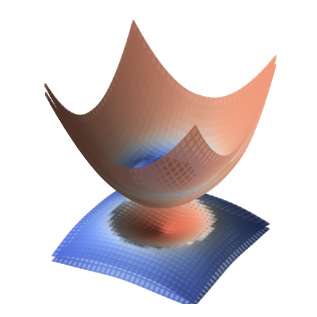
This inverted band structure has been experimentally demonstrated [Phys. Rev. Res. 4, L042042 (2022)], revealing a robust gap (~45 meV) stable up to 100 K. In collaboration with the University of Würzburg, this breakthrough has enabled, for the first time, the observation of quantized edge conductance at temperatures close to 77 K [M. Meyer et al., Sci. Adv., 2025].
These results now pave the way for a detailed exploration of topological edge states, in particular their stability against perturbations and the mechanisms responsible for their long-distance degradation — a crucial step toward the realization of high-temperature functional topological devices.