Spin-dependent photoconductivity in 2D materials
Electron spin resonance (ESR) is a spectroscopic technique that uses an electromagnetic wave to probe unpaired electrons, whether originating from point defects, paramagnetic centers, or conduction electrons. Commercial spectrometers generally operate in the X-band (8–12 GHz), with magnetic fields below one tesla.
At higher frequencies, the GHz–THz photoconductivity spectroscopy developed within the team enables the detection of spin resonances that directly affect conductivity through spin-dependent recombination processes.
This research aims to use this technique to investigate topological gaps, spin–orbit proximity effects, Moiré patterns, and spin dynamics in 2D material heterostructures, to better understand the fundamental spin interactions in condensed matter.
In graphene, this approach has recently made it possible to measure a Kane–Mele gap of about 45 µeV [Phys. Rev. B 106, 245141 (2022)]. This gap, along with zero-field splittings, can be tuned by proximity effects with other two-dimensional materials, by controlling the electric field, spin–orbit coupling, or Moiré effects.
Dimensionality also influences spin relaxation times, which are particularly long in graphene due to its weak spin–orbit coupling. Finally, ESR saturation effects provide a means to probe spin–spin and spin–lattice relaxation mechanisms [Phys. Rev. Appl. 23, 044043 (2025)].
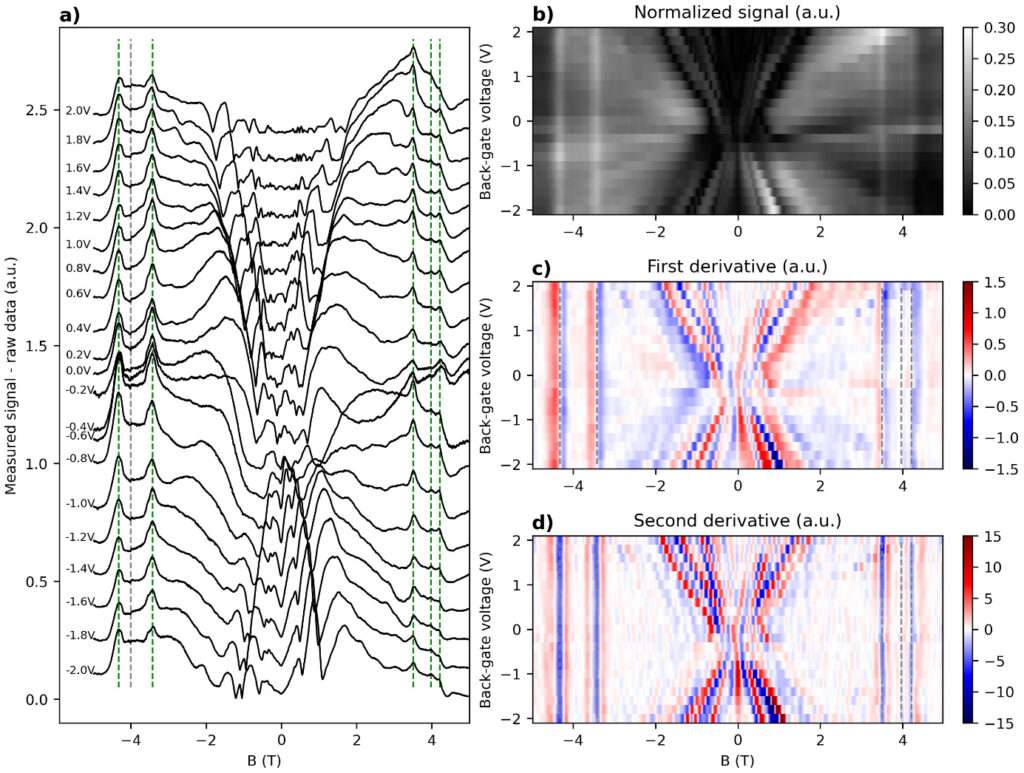
Photoconductivity signal measured as a function of magnetic field for different back-gate voltages. The X-shaped feature at low magnetic fields indicates the presence of Shubnikov–de Haas–type oscillations. At higher fields, several transitions appear clearly as vertical lines. The absolute value of the normalized signal is shown as a color map in (b), with the first and second derivatives displayed in (c) and (d), respectively. Credit: Phys. Rev. B 106, 245141 (2022).