Physics for the environment and health
Climate change, chemical pollution, resource depletion, and biodiversity loss are four major environmental challenges that currently affect—and will continue to impact—human societies and our health. Our team addresses these issues through several collaborative research projects:
- 2D materials for gas detection in composting environments: From material growth to application, this project aims to develop 2D material-based sensors for gas monitoring during composting. (https://fde.umontpellier.fr/2023/composteur/) (Funding: MITI COMPOST, Labex NUMEV, UM TraDIDEG; Collaboration: ICGM)
- Graphene as a conductive platform for electrochemical sensors: We are developing graphene-based sensors functionalized with molecularly imprinted polymers for the detection of micropollutants in aqueous environments. (Funding: ANR MIGRASENS 2021–2026; Collaboration: ICMN, Annealsys; https://anr.fr/Projet-ANR-20-CE04-0011)
- Non-invasive measurement of sap flow in plants: We have developed and refined a non-invasive method using a heat pulse, tracked by a thermal camera, to measure sap flow. Our team contributes to both instrumental development and the physical modeling of observed phenomena (coupled thermal/electromagnetic modeling using FreeFEM). (Collaboration: Eco&Sols, LMGC, IES; Funding: MITI TIMFLOW)
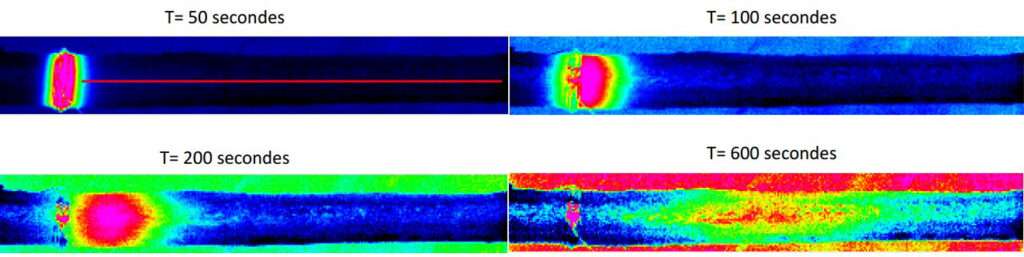
Heat front measurement using IR thermography https://hal.science/L2C/hal-04445925v1
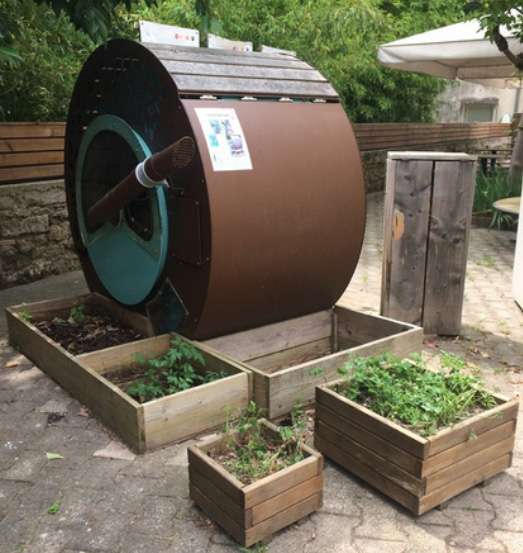
Instrumented composting fountain installed on the esplanade of the cafeteria at the Faculty of Education in Montpellier. This composting fountain is equipped to measure various parameters such as temperature, humidity, and gas concentration (CO₂, CH₄, N₂O) to study and optimize the carbon footprint of composting