Solid State Quantum Technologies (S2QT)
Coordinator : Isabelle ROBERT-PHILIP
| CNRS Researchers: DREAU Anaïs FINCO Aurore JACQUES Vincent ROBERT-PHILIP Isabelle Teaching Researcher (UM): CASSABOIS Guillaume Research Engineer: VALVIN Pierre Emeritus: GIL Bernard | PhD Students: BEIGNON Romeo CACHE Félix CLUA-PROVOST Tristan IBANEZ Alexandra MAURYA Priya Prakash MORANDINI Alicia PLO Juliette SCHRADER Carolin SFEIR Elias TOURNAUD Jessica WANE Elijah Post-Doc: VELLIYUR RAMACHANDRAN Krithika Researcher under contract: MESPLE Florie |
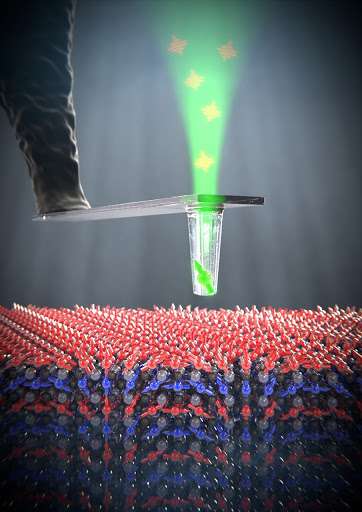
The Solid State Quantum Technologies (S2QT) team conducts research in two main areas.
- The first focuses on semiconductors and two-dimensional materials with wide bandgaps. The goal is to understand and control their optical and phononic properties, as well as to design new photonic components in the UV and IR spectral ranges. These studies are supported by a unique optical microscopy setup that operates up to UV-C.
- The second research area explores and exploits the quantum nature of single defects in semiconductor crystals, isolated in either bulk materials (such as diamond or silicon) or two-dimensional materials (such as hexagonal boron nitride). These efforts aim at applications in quantum communications and sensors, with the objective of developing optically active and scalable quantum interfaces, as well as versatile sensors with ultimate sensitivity and spatial precision.
Research fields :

The research carried out within the team covers several current research themes: physics for quantum technologies, materials science, and advanced photonics. This work addresses both fundamental and applied aspects, by exploring and building on quantum effects at the nanometric scale. Our activity is developed along four lines:
- Single color centers in silicon
We investigate the photon and spin quantum properties of individual optically active point defects in silicon, combining the best attributes of atomic and of condensed matter systems for fiber-based quantum communications and quantum integrated photonics. - Quantum sensing with spin defects in 2D materials
We explore the properties of spin defects in hexagonal boron nitride (hBN), which are promising candidates for the development of flexible 2D quantum sensors, enabling atomic-scale probing of phase transitions in 2D materials under extreme conditions. - Nanoscale imaging with NV centers in diamond
Using single spins isolated in diamond, we develop and use versatile quantum imaging tools at the nanoscale, enabling us to investigate the properties of emerging magnetic and multiferroic materials, paving the way for advances in spintronics. - Ultrawide-bandgap semiconductors for deep-UV optoelectronics
We explore the physics of ultrawide-bandgap semiconductors for applications in deep-ultraviolet optoelectronics. Our activities are currently focused on hexagonal boron nitride, a 2D material with outstanding properties for deep-ultraviolet devices.
Equipments :
The team operates several spectroscopy setups covering a broad spectral range, from the ultraviolet to the infrared, capable of functioning in extreme condition of pressure (>10 GPa) and temperature (<200 mK), and specifically designed for the study of single emitters. It is also equipped with multiple NV-center imaging systems, operating in both scanning and wide-field configurations.
A distinctive feature of the team’s experimental platform is the presence of a scanning, achromatic optical microscope that is diffraction-limited down to the UV-C spectral range (λ ~200 nm), enabling the study of samples in a cryogenic environment with a spatial resolution comparable to the wavelength.
Recent theses :
- ROUSSEAU Adrien (2020-2023)
- ROLLO Maxime (2019-2022)
- BARON Yoann (2019-2022)
- FABRE Florentin (2018-2022)
- DURAND Alrik (2018-2021)
- ELIAS Christine (2017-2020)
- HAYKAL Angela (2017-2020)
- TANOS Rana (2017-2020)
- CHOUAIEB Saddem (2016-2020)