Physics of Glasses (VERR)
Coordinator : Bernard HEHLEN
| Teaching Researchers: FORET Marie HEHLEN Bernard RUFFLE Benoît WEIGEL Coralie | PhD Student: PERRADIN Julien |
From a fundamental perspective, the physical properties of the glassy state and the mechanisms leading to glass formation remain poorly understood. Despite more than fifty years of scientific activity and the emergence of a wide range of experimental, theoretical, and conceptual approaches, this field continues to represent one of the open questions in condensed matter physics.
The study of vibrational and relaxational properties through optical spectroscopies, along with the analysis of structural properties via molecular dynamics using both classical and quantum methods, constitutes the main research directions. Recently, the group’s interests have expanded toward the investigation of the physical properties of living systems and biomolecules.
Glass physics

The combined use of innovative optical spectroscopies applied to glasses under high pressure has led to significant advances in understanding elastic and vibrational properties and their relationship to structure and disorder at the molecular and nanometric scales.
These experimental data, combined with numerical simulations, have helped clarify the origin of glass polyamorphism. For example, the polyamorphs of vitreous silica under pressure can be associated with percolating clusters of polyhedra with progressively higher coordination numbers.
Furthermore, in collaboration with Sorbonne University and National Taiwan University, we have developed innovative picosecond acoustics techniques that have provided deeper insights into energy transport properties in disordered materials—particularly how acoustic phonons, which carry energy, are affected when their wavelength approaches the scale of structural disorder inherent to the glassy state.
Physics of biological systems
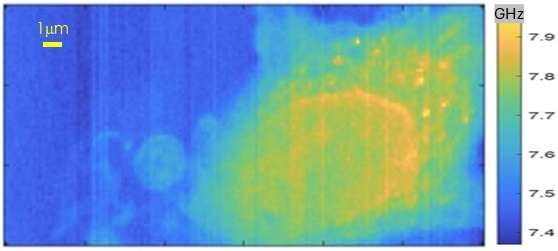
Our research focuses on exploring the viscoelastic properties of living matter through Brillouin microscopy.
This approach has enabled the characterization of the mechanical properties of dental, bone, and retinal tissues, as well as numerous cellular and plant systems.
Owing to our instrumental expertise, we are frequently solicited for collaborations and service projects increasingly oriented toward biological systems.
In parallel, the team performs classical and hybrid quantum/classical (QM/MM) molecular simulations within the new Montpellier IHU, aiming to elucidate interactions between monoclonal antibodies and their CD16a receptor. The objective is to design new therapeutic variants to optimize the efficiency of anticancer treatments.
Instrumental and computational developments
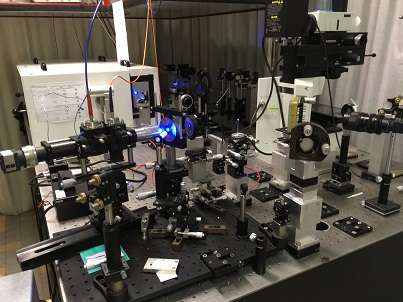
This research area is supported by the team’s strong expertise in both instrumentation and computational modeling. This dual competence has granted the group a recognized position in developing innovative tools applied to both materials and biological systems.
The team possesses a spectrometer combining hyper-Raman and Raman capabilities in the visible (532 nm) and deep infrared (850 nm) ranges, suitable for studying materials under extreme temperature and pressure conditions.
In partnership with the LBN, a confocal micro-Brillouin spectrometer has also been designed to obtain high-resolution 2D and 3D images of the mechanical properties of living cells. This instrument notably allowed visualization of the internal structure of a dental pulp stem cell, revealing its nucleus and organelles.
On the computational side, the team investigates silicate glasses and glycoproteins using hybrid classical/quantum simulations based on the DFTB method—a precise and cost-effective semi-quantum approach enabling the study of rare phenomena such as charge and proton transfers.