Hybrid nanostructures (NSH)
We design coacervate, microgel, and nanocomposite systems by combining polymers with mineral, metallic, oxide, or carbon nanoparticles. We study these systems using radiation scattering to better control their nanoscale structure.
Microgels
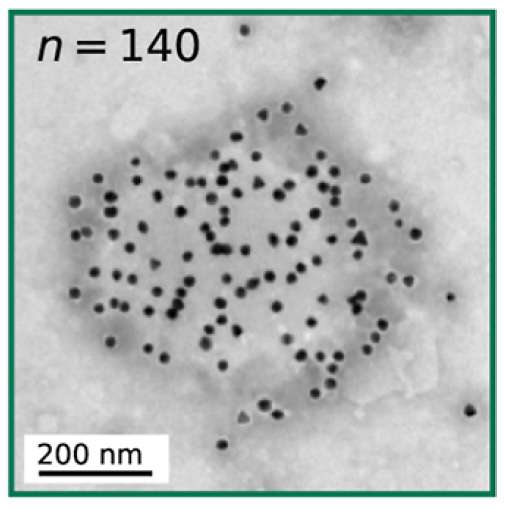
We develop hybrid microgels made of poly(N-isopropylacrylamide) (pNIPAM) and gold.
Their assembly and swelling properties are governed by electrostatic interactions.
Additionally, we study the swelling properties of core-shell microgels with different transition temperatures in the core and shell in suspension or on substrates.
Hybrid mesoporous materials
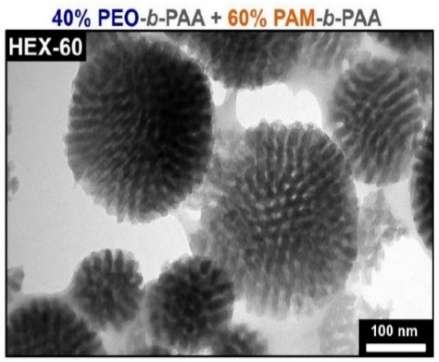
We are studying the assembly of new structuring agents for synthesizing functionalized mesoporous materials. These templating agents, obtained by coacervation of electrostatic complexes, have the advantage of disassembling in water through changes in physicochemical conditions, revealing the porosity of the final material. They also make it possible to control the granularity of the material.
Polymer nanocomposites
We combine radiation scattering (X-rays, neutrons, light) and numerical simulations to describe the microstructure and interfacial dynamics of polymer matrix nanocomposites. This approach allows us to establish the link between the nanoscale structure and the macroscopic (mechanical, electrical) performance of these materials.
Nanocarbon-based nanocomposites
In collaboration with the Nanostructures and Spectroscopies group, we design and study the structure and properties of nanocomposites based on nanocarbons (graphene, carbon nanotubes, or GNPs), nanoparticles, and potentially stimulable polymers. There are potential applications in many areas such as healthcare (drug delivery), the environment (pesticide detectors) and energy (composites for electrical applications).