Soft matter under stress (MMC)
We design model materials and study their mechanical response, plasticity, and fracture when subjected to extreme stresses.
Static properties of non-equilibrium systems
We develop dynamic DNA hydrogels that can reorganise themselves via associative strand exchange mechanisms. This approach endows the materials with exceptional resilience and unparalleled structural adaptability.
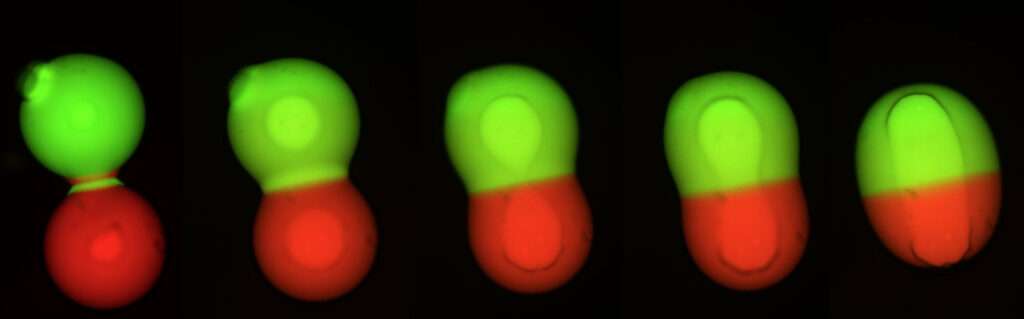
We study colloidal glass transitions in microgravity using systems whose volume fraction can be adjusted by adding thermosensitive polymer dispersions. Introducing polymers into colloidal systems generally allows us to control interactions more finely and understand their properties better at various distances from equilibrium.
Precursors of failure and yielding transition
We observe the microscopic rearrangements that precede gel fracture. These measurements reveal the dynamic features that signal imminent macroscopic failure.
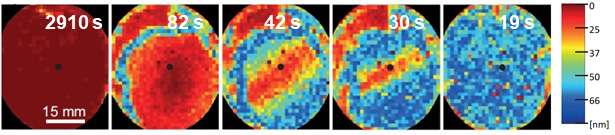
From a rheological perspective, we characterize the transition between the solid and fluid states in colloidal suspensions. We analyze this transition by combining rheological measurements and time-resolved structural studies.

Viscoelastic systems under extreme deformations
We study how droplets deform after impact in relation to the viscoelastic properties of their constituent fluids. By comparing deformations after impact on solid and liquid nitrogen surfaces, we have determined the relative contributions of different flow modes to dissipation.
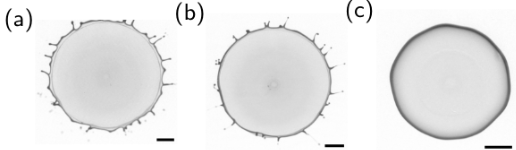

Top-views of the liquid sheets after impact and reconstruction of the transverse section of the bead.
We study the mechanisms involved when a drop crosses a liquid-liquid interface by combining numerical and experimental approaches. This involves designing an original experimental device to observe the passage at very high inertia (1000 g).