Diffusive and quantum transport in 2D materials
Our main research focuses on graphene and electronic transport phenomena in this material. We have a particular interest in the quantum Hall effect in graphene and its properties as an electrical resistance standard, as part of the ANR VanaSiC project. Our recent work on graphene encapsulated in hBN is focused on intrinsic transport limitations and electron-phonon interactions.
We also investigate graphene as a magnetic field sensor through the development of Hall sensors based on different sources of graphene in order to assess the influence of various properties and parameters (such as size, carrier mobilty, disorder,…) on the sensors performances (Ghraviti).
We are also developing graphene transistors used to evidenceelectrically detected electron spin resonance effects.
These topics are studied in close collaboration with the TEST team.
Currently, we are exploring new graphene-inspired materials, especially transition metal dichalcogenides such as MoS₂ and WSe₂ (ANR JCJC 2018–2023 https://anr.fr/Projet-ANR-18-CE24-0004). Our goal is to study intrinsic transport properties in these materials (metal-insulator transition) and at their interfaces with contact metals (1D Schottky barriers). This research is directly linked to the development of environmental gas sensors.
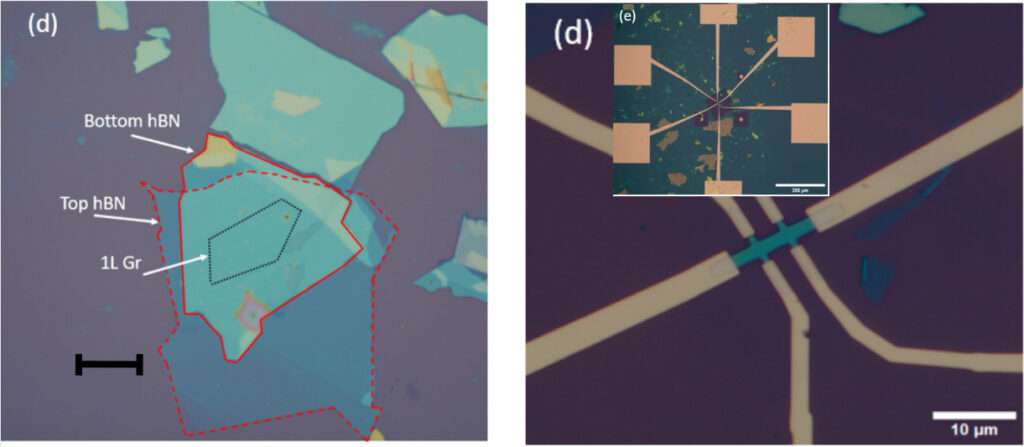
Left: hBN/graphene/hBN heterostructure on a Si/SiO₂ substrate obtained by exfoliation and transfer.
Right: Hall bar of encapsulated graphene (hBN/graphene/hBN) after etching, metal deposition, and electron-beam lithography performed at the CTM (Montpellier). (K. Dinar https://theses.hal.science/tel-05003176 )